Tuesday, April 2, 2013

New Kits: Fiberoptic Dodecahedron Set

New kits are now available for the Fiberoptic Dodecahedron Set! These kits contain all the materials to make the complete pendant and earrings set - including the ear wires and a lovely silk ribbon on which to hang the pendant!

Colorway #1: Turquoise Geode


My current favorite colorway of the three is one I've named Turquoise Geode, which, with its purple AB2X crystals sparkling from the inside-out, looks the most geode-like of the three. I've taken to wearing this one a bunch lately.


Colorway #2: Bronze Lapis


The second colorway, Bronze Lapis, uses bronze and dark blue SuperDuo beads, and denim blue Swarovski bicone crystals for a very earthy feel.


Colorway #3: Red and Gold


The last colorway is red and gold all the way, for a completely blingin' starburst! I'm thinking that this pendant would also make a nice Christmas ornament (hey, you can never start planning for the holidays too early!)


All three kits are available at beadorigami.com, and include all the materials necessary to make the beaded bead, the pendant, and the matching earrings. The kits also include a gorgeous silk ribbon on which to string the pendant, a beading needle, plenty of thread, the Fiberoptic Dodecahedron Set pattern (automatically delivered after checkout as a PDF download), and free shipping is included too!

Friday, March 29, 2013

Tropical Dahlia vs Rivoli Kaleidoscope

While I was weaving some new Tropical Dahlia Pendants, I found myself constantly comparing them to my other rivoli-centric pendant design, the Rivoli Kaleidoscope. It's an instinct I learned while working as an analytical scientist; you're always comparing your current results to previous work. So, to satisfy this itch, I wove a couple of these pendants in the same color schemes so that I could make a direct comparison without considering color differences.
Tropical Dahlia (left) and Rivoli Kaleidoscope (right) Pendants

Center Rivoli vs Outer Rivolis


A big visual difference between the two designs is the focus between the center and outer rivolis. The Rivoli Kaleidoscope has three different kinds of rivolis, and shows off more of the outer rivoli pendants at the expense of the center rivoli. The Tropical Dahlia, on the other hand, leaves much more room to show off the center rivoli. I like that I was able to accomplish this in a rivoli design, as it's often difficult to bezel a rivoli with beadwork without covering most of it up.

Tropical Dahlia Pendant

Symmetry Difference


Another difference between the two designs is the symmetry difference; the Tropical Dahlia Pendant has 10-fold symmetry, while the Rivoli Kaleidoscope has 8-fold symmetry. This difference not only gives the Tropical Dahlia more detail, but it's also reflective of the symmetries that you're more likely to see in a flower vs. a kaleidoscope.

Tropical Dahlia (left) and Rivoli Kaleidoscope (right) Pendants

Of course, as I mentioned earlier this week, the Tropical Dahlia Pendant can be woven in 12-fold symmetry for a larger variation. A larger variation of the Rivoli Kaleidoscope can be created too, and both patterns describe the changes necessary to create these larger variations.


Size Matters?


Finally, the Rivoli Kaleidoscope is ever so slightly larger than the original Tropical Dahlia, but it's also slightly smaller than the larger Tropical Dahlia variation.

Tropical Dahlia (left and right) and Rivoli Kaleidoscope (center) Pendants

They range from 27 to 32 mm in diameter.

The patterns for the Rivoli Kaleidoscope Pendant and Tropical Dahlia Set are available exclusively at beadorigami.com if you'd like to make your own!

Which design is your favorite? Drop me a line in the comments section below!

Monday, March 25, 2013

Tropical Dahlia Pendants: Larger Variations

While I was designing the Tropical Dahlia Pendant, I experimented with the idea of using a larger central rivoli in the middle of the pendant...

Original Version: Ten Units


The original Tropical Dahlia Pendant has ten units of beadwork around the central rivoli; ten rizo beads, ten Czech teardrop beads, and ten rivoli pendant crystals, accompanied by a collection of Japanese seed beads.


Larger Variation: Twelve Units


To create the larger variation, I used an 18 mm rivoli in the center, and increased the units of beadwork from ten to twelve. The result is a slightly larger pendant with the rotational symmetry of a clock face! Can you see the difference?


This variation also required some additional minor adjustments in the size and count of the seed beads on the back of the pendant, which I describe in detail in the Tropical Dahlia Set pattern.

I think that a collection of Tropical Dahlias in these two different sizes would make a gorgeous necklace...


The pattern for the Tropical Dahlia Set is available exclusively at beadorigami.com if you'd like to make your own!

What's your favorite kind of variation on a beading pattern? 

Friday, March 22, 2013

New Pattern: Tropical Dahlia Set

Just in time for the spring, my newest beading pattern is now available!


A Beaded Blossom Pendant


The Tropical Dahlia Pendant is the focal piece of this two-pattern set. I previously blogged about my design goals behind this pendant and the origin of its name, but basically, I wanted to design something with the new rizo beads in a floral theme. This pendant is the result of those efforts.


I labeled this pattern as an advanced design because it uses some unusual thread paths, and you have to be very careful not to weaken or cut your thread on the edges of the crystals when you add them to the beadwork. However, the pattern includes tons of illustrations and photos, so anyone with experience in the right angle weave, peyote, and netting stitches should be able to follow this rizo bead pattern. This design shares some ideas that I previously explored with the Rivoli Kaleidoscope Pendant, but it expands on these concepts for a more flower-like design.


Matching Earrings


Finally, since I've been working towards a goal of designing a matching pair of earrings for each of my new pendants, I wove some Mini Tropical Dahlias that fit this role perfectly!


I'm particularly proud of how the centers of these little flowers face out and not down when the earrings are worn. This took a lot of fiddling to get right, but I'm really happy with how they turned out!


The pattern for the Tropical Dahlia Set is available exclusively at beadorigami.com if you'd like to make your own!

Monday, March 18, 2013

Definitely a Dahlia!

What's in a Name?


Thanks to everyone who contributed a name idea for my new beaded pendant with rizos and rivolis! After consideration of the suggestions made on this blog and on my Bead Origami Facebook Page, I took to Google's image search to see how the subjects of these names matched the original pendant.


A close second was an anemone flower (a name I, embarrassingly, first took for a sea anemone), but when I came across this picture of a gorgeous dahlia, it was a perfect match!


Color-Matching Exercise


I also learned that dahlias come in several different varieties and colors, from pure white to speckled dark purple. On occasion, I like to do color-matching exercises by creating a piece of beadwork from a photo, and this photo of an orange dahlia looked like a challenging candidate for this exercise.


I chose rose peach Swarovski crystals and matching rizo and Czech drop beads for the petals, and a luminous green crystal for the center rivoli. The crystal in the center is a little big compared to the center of the dahlia in the photo, but the orange beads are a great match!


Again, thanks again to everyone who contributed name ideas for this design! The pattern is coming soon!

Friday, March 15, 2013

Fiberoptic Easter Egg Earrings

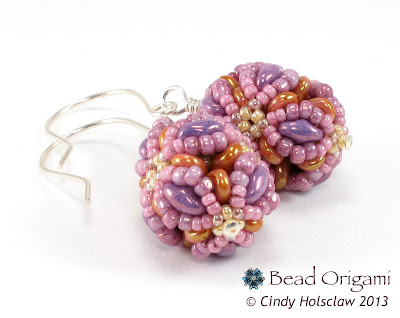
On the heels of creating the Fiberoptic Egg variation of the Fiberoptic Octahedron beaded bead, I've put together three pairs of earrings using this design!

Fiberoptic Easter Egg Earrings


The first is in very floral pinks and purples, with just a touch of orange and yellow:


The next pair is in tealish-green with purple:


And the last is in silver and black, since this color combination goes with everything.


All three pairs of earrings are available in my Etsy shop!

The Fiberoptic Egg beaded bead is a variation on the Fiberoptic Octahedron from my Fiberoptic Duo Beaded Beads pattern. This SuperDuo beading pattern is available exclusively at beadorigami.com if you'd like to make your own!

Thursday, March 14, 2013

Fiberoptic "Egg" Beaded Bead

As a full-fledged science and math nerd, I like to explore many possible geometry variations in my beadwork. Along these lines, I recently wove a new variation of my Fiberoptic Duo design:


The beaded bead on the left is an original Fiberoptic Octahedron, one of two beaded beads described in my Fiberoptic Duo pattern, while the beaded bead on the right is the variation; a Fiberoptic Triangular Bipyramid.

Octahedron vs. Triangular Bipyramid


While their names sound nothing alike, the octahedron and triangular bipyramid (aka triangular dipyramid) are actually fairly closely-related polyhedra. Both have sides made up only of triangles, and when the sides in the triangular bipyramid are equilateral, these polyhedra make up two of the eight deltahedra. This is a special class of structures where all of their sides are made up of equilateral triangles.

You can think of a triangular bipyramid as two tetrahedra stacked up against each other. I also like to think of it as an octahedron that's just missing two of its sides. A triangular bipyramid has six sides instead of the eight in the octahedron, and nine edges instead of twelve.

A Geometry Variation


Because it's so closely related the octahedron, the triangular bipyramid makes for a straightforward variation on an octahedron beaded bead design. I wove this variation by skipping just one repeat of a step in the original pattern, and by substituting the seed beads in the core of the beaded bead with 15° seed beads. The tricky part is the seed bead overlay: I had to use quite a bit of thread tension to get this overlay to fit right without too much thread showing through. 

The resulting beaded bead is oval-shaped, and slightly taller than the original octahedron. Maybe it's because Easter is coming up, but it looks a little like an egg to me:


I had some fun balancing this beaded bead on its precursor:


Even one of my tiny paper cranes got in on this balancing act:


Fiberoptic Egg Earrings


Finally, I incorporated this beaded bead and another into a pair of earrings. Aren't they cute? I'm beginning to prefer oval-shaped beaded beads for earrings compared to round ones... What do you think?


The Fiberoptic Duo Beaded Beads pattern is available exclusively at beadorigami.com if you'd like to make your own!

What's your go-to method for a beaded variation?
Related Posts Plugin for WordPress, Blogger...